

Important Notice (June 12, 2026): In alignment with new United States government export control directives, Anthropic has formally requested that Amazon Web Services (AWS) revoke user access to the Claude Fable 5 and Claude Mythos 5 models. Users currently utilizing other models within the ecosystem, such as Opus 4.8, will experience no service interruptions and may continue their operations with full confidence. For further clarification regarding the scope of this compliance measure, please refer to the official statement from Anthropic.
Introduction: A New Paradigm in AI Performance
The landscape of generative artificial intelligence underwent a significant shift earlier this month with the announcement of Claude Fable 5, a model designed to bridge the gap between high-level reasoning and accessible, enterprise-grade safety. Deployed via Amazon Bedrock and the Claude Platform on AWS, Fable 5 was engineered to handle complex knowledge work, sophisticated software engineering, and high-fidelity vision tasks.
However, the rapid evolution of global regulatory environments has now necessitated a recalibration of access to these frontier models. This article provides a comprehensive overview of the model’s capabilities, the technical requirements for its deployment, and the implications of the latest compliance updates.
The Technical Edge: What Defined Claude Fable 5
Prior to the June 12 restrictions, Claude Fable 5 was positioned as a "step-change" in AI capability. Built for ambitious, long-running workflows, the model demonstrated state-of-the-art performance across nearly all industry-standard benchmarks.
Advanced Architecture and Safeguards
The hallmark of the Fable 5 release was the strategic implementation of a dual-layered safety architecture. Anthropic recognized that as models become more capable, the potential for misuse in sensitive domains—such as cybersecurity, advanced chemistry, and biological research—increases.
To mitigate this, Fable 5 featured an automated "fallback" mechanism. When a user input touched upon restricted or high-risk topics, the model would intelligently route the request to Opus 4.8, a highly stable and well-vetted model. This allowed developers to harness the immense power of Fable 5 for general tasks while ensuring that sensitive inquiries were handled by a model specifically tuned for rigorous safety constraints.
Conversely, Claude Mythos 5—the uncapped, "raw" version of the model—was intentionally limited to a highly vetted group of enterprise and research partners, ensuring that the most potent capabilities remained within a controlled, supervised environment.
Chronology of the June 2026 Rollout
The lifecycle of this model release was marked by rapid iterative updates, reflecting the fast-paced nature of cloud-based AI deployment.
- June 8, 2026: Initial launch of Claude Fable 5 on Amazon Bedrock. The model was made available in the US East (N. Virginia) and Europe (Stockholm) regions, with Claude Platform on AWS support expanding across North America, South America, Europe, and Asia Pacific.
- June 9, 2026: Following initial feedback, AWS updated the console interface to support the
bedrock-runtimeengine, refined model identification parameters, and provided corrected scripting for theprovider_data_shareconfiguration. - June 10, 2026: Technical documentation was expanded to include AWS SigV4 (Signature Version 4) configuration, allowing developers to handle data retention settings via the AWS CLI with enhanced security protocols.
- June 12, 2026: Compliance directive issued. Following new US export control mandates, Anthropic and AWS initiated a total suspension of access to Fable 5 and Mythos 5, prioritizing regulatory alignment over service availability.
Navigating the Infrastructure: Deployment and Configuration
For developers who integrated Fable 5 during its brief period of availability, the process highlighted the evolving complexity of enterprise AI. Utilizing the model required a shift in how data retention and privacy are managed within the AWS ecosystem.
The Mandatory Data Sharing Protocol
A critical requirement for accessing the Fable 5 model was the mandatory opt-in to the provider_data_share mode. Because the model required human-in-the-loop review to ensure safety and prevent abuse, AWS mandated that users set their data retention policies to allow for a 30-day window of input/output storage.
This was achieved through the Data Retention API. For those utilizing the bedrock-mantle or bedrock-runtime engines, this required a direct interaction with the API to set the retention mode, ensuring that the model provider could perform necessary safety audits.
API Integration and SDKs
The deployment of Fable 5 was designed to be seamless for existing AWS users. Whether through the bedrock-runtime endpoint using the AWS SDK for Python (Boto3) or the Anthropic Messages API, the goal was to provide a "unified multi-model experience."
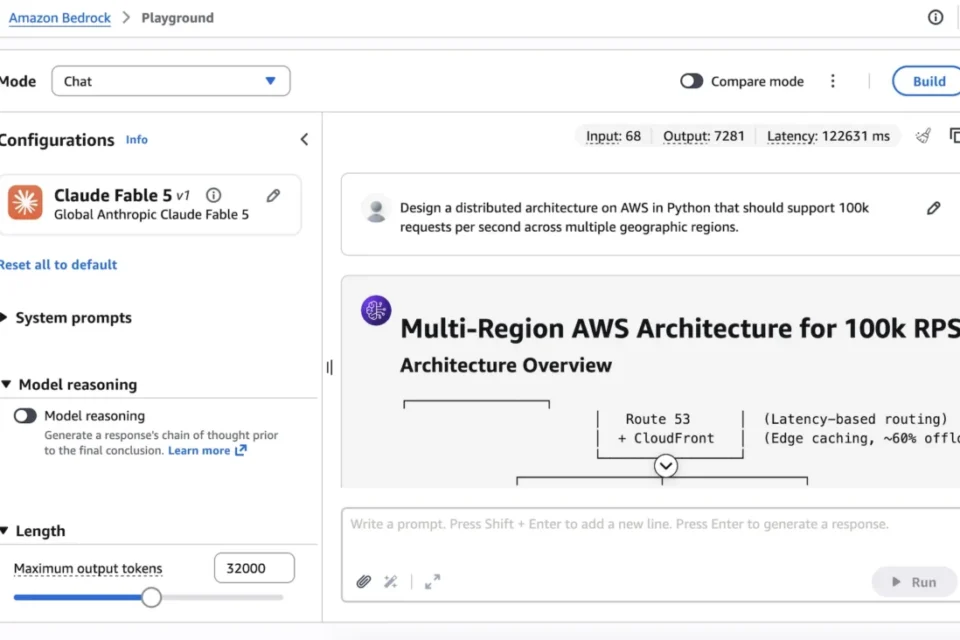
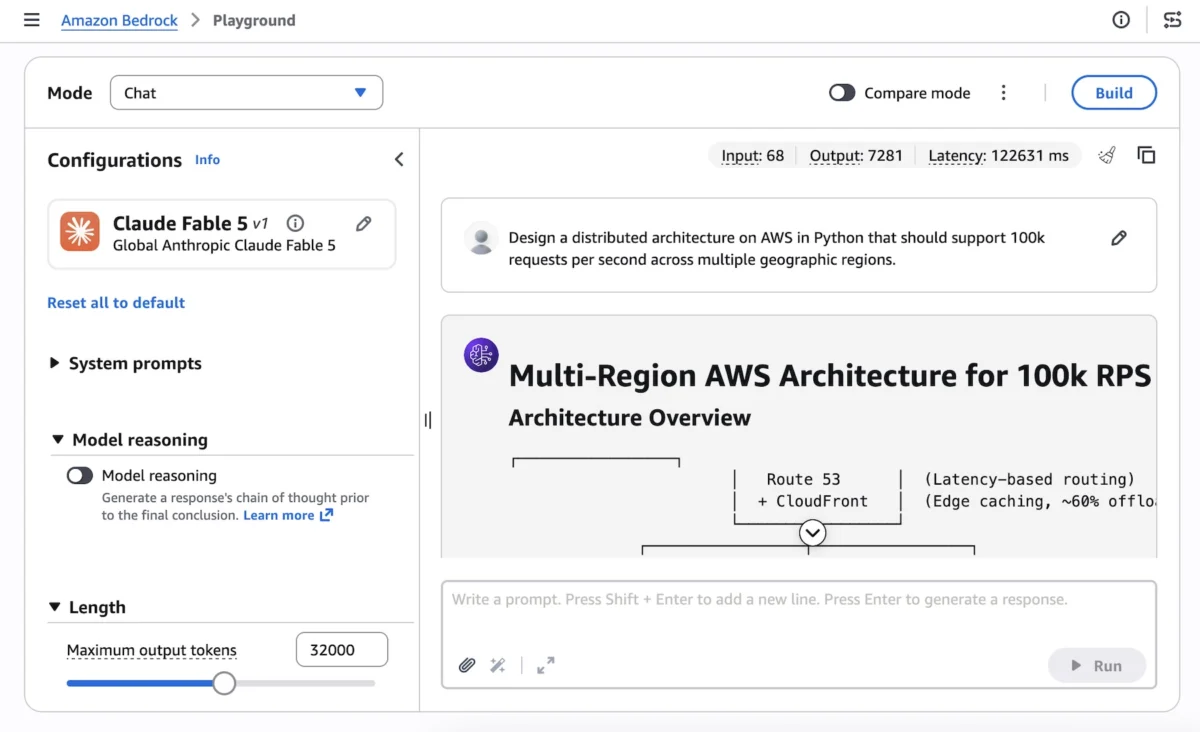
The ability to call modelId="global.anthropic.claude-fable-5" within a converse API request allowed engineers to integrate the model into existing distributed architectures without significant code rewrites. The versatility of these endpoints underscored why the sudden restriction of the model represents a significant logistical challenge for teams that had already transitioned their production workflows to this architecture.
Official Responses and Industry Context
Anthropic’s swift compliance with the US Government export control directive serves as a reminder of the "Geopolitics of AI." As frontier models reach capabilities that touch upon national security, the intersection of private sector innovation and public policy becomes increasingly blurred.
AWS and Anthropic have maintained a transparent line of communication throughout this process. By keeping the Opus 4.8 model operational and unaffected, they have ensured that the broader enterprise AI ecosystem remains functional. The decision to revoke access to Fable 5 and Mythos 5 is widely viewed by industry analysts as a proactive measure to avoid the friction of future litigation or sanctions, demonstrating a "safety-first" culture that defines the partnership between the two companies.
Implications for the AI Ecosystem
The restriction of Claude Fable 5 carries several long-term implications for organizations building on Amazon Bedrock:

1. The Risk of Model Dependence
This event serves as a case study in "model lock-in." When developers rely on cutting-edge, proprietary models that are subject to sudden regulatory shifts, their infrastructure becomes vulnerable to external policy changes. This will likely drive a renewed interest in hybrid models or the use of multiple providers (Model Agnostic Architecture) to ensure business continuity.
2. Heightened Focus on Compliance
Data retention and safety, once considered "backend" issues, are now at the forefront of the developer experience. The necessity of using the Data Retention API and opting into human review for advanced models suggests that future AI models will be increasingly subject to "regulatory gating"—where access is contingent on granular data oversight.
3. The Future of "Export-Controlled" AI
We are entering an era where AI models are treated similarly to advanced silicon chips or high-end encryption software. Organizations must now prepare for a future where access to specific "frontier" model versions may be restricted by region, industry, or even the nature of the specific application being built.
Conclusion
While the suspension of Claude Fable 5 and Mythos 5 may disrupt immediate development roadmaps, it is a definitive marker of the maturity of the AI sector. The transition from an experimental phase to a regulated, enterprise-grade industry brings with it the complexities of international trade, national security, and strict data governance.
For developers and enterprises, the path forward is clear: diversify your model dependencies, ensure your data retention policies are compliant with current mandates, and maintain close contact with your AWS support representatives. While Fable 5 may be unavailable for the time being, the infrastructure that supports it—and the broader suite of models like Opus 4.8—remains a robust foundation for the future of AI-driven innovation.
For the latest updates regarding model availability, users are encouraged to monitor the AWS re:Post for Amazon Bedrock and the official Anthropic newsroom.
